Tuesday, October 11, 2011

Photo Gallery for Today: Scenes from Zuccotti Park

Scenes from the Occupy Wall St. demonstration at Zuccotti Park in lower Manhattan. The evening of 10/10/11
all photos the property of F. LoBuono

The Corner of Broadway and Liberty Street, one of the entrances to the park
There was a fair amount of young families who were participating.
The wall that outlines Zuccotti Park on the Liberty St. side.
Sign making.


Most of the demonstrators are young people.
Many discussion, both public and private were going on.
Many ethnicities participated.
The very respected Randall Pinkston at our "live" camera position.
Randall with cameraman Gary Cohen.
By late in the afternoon, the park is overflowing with demonstrators.
WCBS reporter Katherine Brown
The corner of Broadway and Liverty
The huge crowds listened to speeches in the heart of Zuccotti Park.


Somebody threw-up color on this guy!
The NYPD was actually a very relaxed presence on this day.
An impromptu march up Broadway.


The Flag Man!


I made these photos while on duty covering the Occupy Wall St. demonstration in Zuccotti Park in lower Manhattan that has lasted nearly a month now. Having been able to observe it all for hours and with a unique perspective, I'll share some of my thoughts on what's going on down there in a later entry.

The park is located at the corners of Broadway and Liberty Street (somehow prophetic, don't you think!). The photos were made in and around the park on the late afternoon and evening of 10/10/11.

Sunday, October 2, 2011

New Contributor: Clea Carchia


Please welcome our latest contributor, Ms. Clea Carchia, with this wonderful, short story for children.

The Hound Dog and the Pigeon

A children’s story

By Clea Carchia

There was once a hound dog puppy named Fender. He was born into a prominent southern Appalachian family, known for their hunting skills. Every morning while he and his littermates snuggled close to their mama, he would see his pack leave the house with their human masters. A few hours later they would return with their spoils, a pheasant, a turkey or some other small feathery animal. His canine family was proud that they were known for generations as having great talent and instinct for the chase . . . but Fender was different. He felt bad for the birds. In fact, he kind of liked them. Of course he didn’t tell anyone. What kind of freak was he? A hound dog who didn’t want to hunt.

Late summer turned to autumn. The days had grown shorter and cooler and the leaves on the trees had started to turn. Fender had grown from a cute fuzzy ball of fur to a tall, beautiful, athletic young dog. He kept his big secret to himself until the day came for him to go out with the rest of the pack on his first hunt. This is an important coming of age ritual for hound dogs. The air was buzzing with anticipation and excitement. His worth was going to be judged on how well he could track and point.

The morning was crisp. Humans were cleaning their guns and packing provisions for the day. A group of men led the dogs into a big truck and headed for the woods. Fender’s healthy, sleek, black and white coat glistened in the sun as they hiked up the mountain in search of prey. The human hunters spotted a flock of grouse who had stopped to rest at a nearby pond. This was it . . . Fender’s big test. The leash came off and he ran toward the grouse. But instead of tracking quietly and reporting back to his humans, Fender ran right at the group of birds chasing them all away! “Go! Get out of here!” He screamed, “The humans are coming to kill you!” The grouse took to the air and all flew away, unharmed.

Needless to say, this did not go over well with Fender’s master. He was very disappointed with this type of behavior. It was unheard of! What kind of hound dog doesn’t want to hunt? Feeling like a reject, head lowered, Fender followed the humans back onto the truck and started for home, or so he thought. They stopped at an old broken down building. There was a lot of barking and many angry dogs jumped against a tall chain link fence. It smelled bad. Fender was scared. His master pulled him out of the truck and yanked the leash hard, pulling him toward the door. Fender struggled. They entered the building and his master left him without even looking back.

Frightened, Fender cowered in the corner of a smelly concrete pen. A large, gruff, unsmiling woman glanced at him briefly, then looked back at her computer. After some time without food or water, a tall thin man approached. He put Fender on a leash and led him out to an area with a lot of separate enclosures. There was one dog in every cell. The man put him into one of the runs and walked away. Fender looked up at cinder block walls and out through holes in the chain link in front of him. The floor was cold. Wind was blowing rain through an opening in the back of the enclosure that led to the outside. Fender missed his family. He shivered and shook until he finally fell asleep.

Fender woke up to a lot of loud barking, howling and jumping. The tall thin man opened the pen of a straggly looking old black dog with wiry fur and gray around his mouth. The old boy’s eyes were wide and frightened. He was dragged down a long hall, into a dark room. Everyone knew that once you went into that room you never came out. It was usually after you had been at the shelter for a while and no humans had come to rescue you . . . or if you were old and sick. Fender did not like this new place one bit and he was so sad his human family had chosen to abandon him. He crawled to the back corner of his cell, curled up, and put his head underneath his paw.

Days turned into weeks. Every day at least one dog would take the walk to the one-way room . . . the room with no exit. “Maybe it was better than suffering like this anyway,” he thought. No one loves me anymore. There’s no point to living.

One day three young humans came into the shelter. Everyone was curious. “Why are they here?” Fender thought. They were laughing, smiling and talking to the dogs. They seemed so nice. Suddenly, one by one, the tall thin man opened the pens and handed off the dogs to the group. It seemed like forever before they reached Fender’s run. Finally they opened it and led him out. Fender and about 20 other dogs were loaded into a big van. They drove off and away from the horrible place. They drove and drove until it was dark. When they arrived at their destination all the dogs woke up and stretched. They were led into a building and put in pens where they went to sleep for the night.

In the morning when they woke they could see this place was much better than the last place. It didn’t smell so bad and the people were nice. They were played with, given toys, and allowed to go outside together. Friendly people would come and sometimes the dogs would leave with them! Fender was so much happier now, but he was still lonely and longed to find a family who would love him.

About a week went by and a woman with red hair came in. She looked around at all the dogs. When she spotted Fender she smiled and pointed at him. One of the young volunteers opened the door and took them out back to get acquainted. They played together for a while. Fender really liked her and tried to act real cute so the woman would pick him. It worked! He walked out with the red haired woman and away from all the other dogs. He felt bad for them, but was relieved to be off of the cold concrete floor and away from the chain link fence. The nice woman took him back to a beautiful house with a big yard where she threw a ball for him to fetch. She lived with a man who was really nice too. She took him for long walks and patted him gently on his head. He was given a nice soft bed to sleep in and many toys. Fender had found his forever family.

Fender lived a very happy life for many years and never knew hardship again. One day a woman with curly hair came to the house. His mommy had to go away for a few days so the curly haired woman took him to her house for a visit. He ran up the steps, through the door and all around, excited to be in new surroundings. He spotted a cage in the corner with a large gray pigeon in it. “How cute! A sweet bird,” Fender thought. He remembered back to the days when he was expected to chase and hunt birds and recalled his whole horrible experience at the first shelter. He put his nose up to the cage and the bird walked over. Fender sniffed. The bird sniffed back. The woman opened the cage and took the pigeon out. “This is Nicky”, she said and lowered the bird down so he could take a look. Fender put his nose up to the bird’s wing and felt how soft his feathers were. He had found a new friend. He was relieved that he wasn’t expected to kill the bird. Fender realized he didn’t feel like an outcast for being different any more and was so happy he was accepted for who he was . . . a hound dog who liked birds!

The end J


Wednesday, September 28, 2011

Photo of the Day

A storefront in San Remy, France.

photo: F LoBuono (all rights reserved)

Monday, September 26, 2011

Social Commentary: On The Death Penalty


Recently, there were two people executed in this country. One was Troy Davis, convicted of killing an off-duty police officer in Georgia in 1989. The other was Lawrence Russell Brewer, convicted with 2 others for the dragging death of James Byrd, Jr. in Texas, also in 1989. Although the motivation and circumstances surrounding each crime were vastly different, each State in which they were tried and convicted applied the same sentence: death.

Both cases received a great deal of publicity. Davis, who maintained his innocence to the very end, was convicted despite several conflicting eyewitness accounts of who actually committed the murder. This, and several other factors, in my mind, certainly created reasonable doubt as to his guilt. Because of this, hundreds, if not thousands, of people who sought to have the case re-opened, took up his cause. The case was presented to the US Supreme Court who refused to hear it and Davis was executed by lethal injection. Brewer’s situation was quite different. He, along with two other friends, lured James Byrd, Jr. into their pick-up truck where they eventually beat him and brutally dragged him to his death by chaining him to the back of the truck. Brewer, a white supremacist, rightly received no public support and few requests for clemency.

Where the execution of Davis may have seemed potentially immoral and Brewer’s entirely justified, I believe BOTH should not have happened. Why? Because I believe that the Death Penalty is in itself, immoral and counterproductive.

In the case of Troy Davis, there were many mitigating circumstances that, as I mentioned, certainly created doubt in the case. 5 out of 7 primary witnesses for the prosecution recanted or changed their testimonies. Davis himself NEVER wavered in his claim of innocence. In fact, his last words before the lethal drugs were administered to him were to the family of the man who was murdered, Mark MacPhail. Davis acknowledged their pain and loss and AGAIN professed his innocence.

Brewer’s situation was quite different. His crime was particular heinous and brutal. James Byrd was dragged for over a mile and when the truck finally stopped, Byrd’s body was so mutilated that he was missing his head and a shoulder. There was never any real doubt as to Brewer’s guilt. So, certainly, in Davis’ case, one might say that his execution should not have occurred. But how could one justify clemency in Brewer’s case?

As I see it, there are two, main issues to be considered here. One is legal, the other moral. Legally, the issue is how the death penalty is applied. What separates one brutal crime from another? Is shooting an unarmed man in the course of a robbery as heinous as tying a man to the back of truck by a chain and dragging him to his death? Logic (and emotion) would say “no”. Yet, the death penalty was applied in both of these cases. Should ANYONE who takes another persons life pay by forfeiting their own?! Who is the arbiter who decides one murder is worse than another?

In the case of Davis, from my research, REASONABLE doubt was certainly created. One of the key tenants of our legal system is that someone must be found guilty beyond reasonable doubt. Davis was not the first, and, unfortunately, will not be the last person who was executed with less than rock solid evidence to support their death sentence. Furthermore, the spirit of American jurisprudence is that it is better to see 10 guilty men go free then to punish one innocent man. This, in its essence, makes American justice virtually unique in the world. Most systems are the opposite: if you are charged, you are presumed to have committed the crime you were accused of and it’s up to you to prove your innocence. Oddly enough, the European countries that have adopted this philosophy have abolished the death penalty, citing it as cruel and barbaric. Yet, the US continues to execute people at what some would call an alarming rate. It is entirely reasonable to think that, with so many executions, mistakes were made and innocent people were executed. This is completely unacceptable. In fact, a few years ago, the governor of Illinois was so concerned by the flaws in the system that allows innocents to be executed that he abolished the State’s death penalty law.

Then there is the moral issue. Does the State have the right to take one of its citizen’s lives and call it justice? Some would say, “of course it is”! Citing a case like the murder of James Byrd, Jr. by Lawrence Brewer and others, they might say, “if not applied here, then where”? But isn’t that a reaction triggered more by emotion and the need for vengeance rather than justice? The crime that these men perpetrated was particularly heinous. Our emotions would scream out that the criminals should at least suffer as much as the victim. But, again, this is vengeance, not justice. I have tried to put myself in the position of one of the family members of James Byrd, Jr. and try to feel what they might have felt. How would I react if that happened to my father? I would hope that I would react as Ross Byrd did. Ross Byrd (32) is the son of James Byrd, Jr. He actually fought to prevent the execution of Lawrence Brewer. He repeatedly wrote to the State of Texas seeking clemency for Brewer. In a statement released just after Brewer’s execution, Ross Byrd said, “you can’t fight murder with murder”. Other family members did not feel this way but Ross was steadfast in his opposition to the death penalty in not only his father's case but in ANY case.

Byrd’s stance is a bold and controversial one. But it is also powerful. Here is a man who was affected by the most horrible of crimes and is still reaching for a higher ideal, the ideal of TRUE justice. The State cannot, under ANY circumstance, justify the taking of one life by the taking of another. In a sense, that then becomes institutionalized murder. The message sent by the State is counterintuitive: you cannot discourage violence by committing violence. As Einstein so well put it when talking about making a real commitment to peace: “you cannot simultaneously prevent and prepare for war”. They are divergent paths. A choice must be made. As a society, do we condemn violence by punishing those who commit violence with more violence and brutality? Or do we choose a path where we renounce violence in all its forms, especially as it is practiced by an all-powerful State?

There will be those who will argue that the Death Penalty must be used as a tool to deter violent crime. But it’s really quite easy to find the research that completely counters that claim. It fact, it has been statistically proven that it is NOT a deterrent to violence.

I am often amazed by the irony that can be found in the deepest of issues – like the one. The case in point that comes to my mind is the Great State of Texas (and, in many ways, it IS great). Texas, which is politically dominated by Conservative Christians execute, by far, more people than any other State in the Country. I find it odd that so many Texans follow the slogan “what would Jesus do?” while at the same time condemning hundreds to death. I’m sure that some would defend this dichotomy by saying, “an eye for an eye, says the Bible”. Well, I would counter with “vengeance is mine, sayith the Lord”.

Look, I’m not so naïve to think that if we abolish the Death Penalty all our problems with violence will go away. There are some deeply routed social, economic, and moral issues that we haven’t even touched on that need to be cited, too. I think punishments should fit the crime and serve a greater purpose, like rehabilitation when, and where, possible. In the case of a Capital Crime, you would receive the most severe punishment: i.e. total loss of your freedom for the rest of your life. If you take a life, you forfeit yours in terms of your freedom. And there would be NO parole for those will not, or cannot, be rehabilitated.

We have to distinguish between justice and vengeance. Justice seeks a greater good, a higher ideal. Vengeance is like cheap sex: it’s an orgasmic release, feels good at the time, but leaves you hating yourself in the end.

Friday, September 16, 2011

Social Commentary: On Unions


A recent discussion I became involved with on Facebook on the state of the US economy, included a lively exchange on the current position unions occupy in the business world. It started when I objected to a friend's assertion that the the difficulties we are now experiencing with our economy were, if not completely, mostly caused by President Obama's ineffectiveness as a leader. I countered that this was an over simplification. Certainly, the President has made some mistakes. However, I believe that the root of the problem lies much more with the intractability of the Republican Party in general, and, so-called Tea Party Republicans in particular. From what I have read and heard from virtually every economist, regardless of their political party affiliation, is that some spending (some even said a LOT) by the government was absolutely necessary to create jobs and jump start the economy. I believe this is what we call a stimulus package, something the Obama administration is desperately trying to sell to the American people. And the major reason it is such an uphill fight is that the Tea Party has stonewalled every move by the President to effectively raise the debt limit by raising taxes, particularly on the wealthy and corporations, or spend money to create government jobs that would do meaningful work like improving the country's infrastructure (which so desperately needs it). Now you know why they have been dubbed as The Party of No. To me, at times, they seem as spoiled children who only want what they want and say"NO" to every effort to try to appease them.

Be that as it may, the discussion eventually came to how, if unions were abolished, the business environment would experience a breath of fresh air that, along with virtually no regulation on them in terms of environmental protection or other safe guards, would issue in a new era of economic growth that would save the country. WTF?! To me, that's a recipe for disaster!

Unions, often the only line of protection for workers against greedy and powerful business concerns, have been around for hundreds of years. They started as guilds or organizations of skilled workers who would ban together to find strength in numbers to protect themselves against, you guessed it, GREEDY AND POWERFUL BUSINESS CONCERNS. They were created because they were needed and they still are!!

Guilds morphed into unions over the years but still serve the same purpose; to give the worker a voice in how he is treated and compensated in the workplace. Many who argued against unions claimed that, perhaps, at one time, unions were necessary but they are no longer needed. This is another WTF?! Certainly, the most dramatic examples of the need for unions came after the Industrial Revolution of the late 19th Century and early 20th Century. Before them, BIG BUSINESS had little concern for the health and well being of its workers. In fact, they were down right abusive. At great cost, unions fought BIG BUSINESS for even the most basic human rights at the work place. Without the unions we might still have child labor, unlimited work hours, unsafe work environs, and piss poor pay!!!!

And this is still true today. How many miners have to die because BIG BUSINESS cut corners on safety to increase profits for you to realize that, without the UMW, a relatively rare occurrence could happen on nearly a daily basis? How many people would be terminated after years of struggle only to be replaced by a younger, less skilled, and cheaper one, without the union? How many industrial workers would be exposed to danger caused by callous bosses whose sole mission is to increase productivity and cut costs without the union? No, my friends, without the unions, BIG BUSINESS will declare open season on American workers.

That's the emotional side of being a union supporter. But there is a practical side, as well. And it plays directly in THE PARTY OF NO's plans to stimulate the economy. Of course, as THE PARTY OF NO, they will miss the point - they're too busy saying, well, NO! I am a union member: IBEW Local 1212 in NYC. Now, I don't work in a coal mine but I need my union just as much. As a TV journalist, I work in an extremely competitive, stressful, demanding, and, sometimes, dangerous profession. And, quite frankly, I am well compensated for it. However, I honestly believe that, without the union, I would be exposed to the same challenges I mentioned WITHOUT the proper compensation. As it is, I am required to work long hours under difficult conditions (hurricanes, fires, floods, warfare, etc.). Now, because of the union, at least I am fairly compensated for it. Without it, I KNOW that this would not be the case. It's already happening within our profession. TV News stations have made a strong move to hire younger, less experienced, NON union workers for far less money then they have to pay us.

Here is where THE PARTY OF NO gets it all wrong when it comes to the REAL economic impact of unions: because I am well compensated, I feel that I am in a position to live a relatively comfortable life. What does this mean? It means me and family buy things - things like homes, cars, appliances, vacations, etc! We pump money into the economy!! Now, I'm a photojournalist not an economist but isn't that Economics 101? Unions ARE the stimulus!!

Some in THE PARTY OF NO would say that, in a free society with a free market economy, businesses should be allowed to hire whom they want and compensate them at any rate they want. Really? Well, let me put that in perspective for you. During recent contract negotiations between CBS News and the IBEW that represents its technicians, CBS was taking a hard line looking for major concessions from the union. And they did this while raking in record setting profits - enough profit to compensate CEO Les Moonves to the tune of $87 million a year!!

Well, this time I'm saying NO! No, you will not take our UNIONS!!

Thursday, September 8, 2011

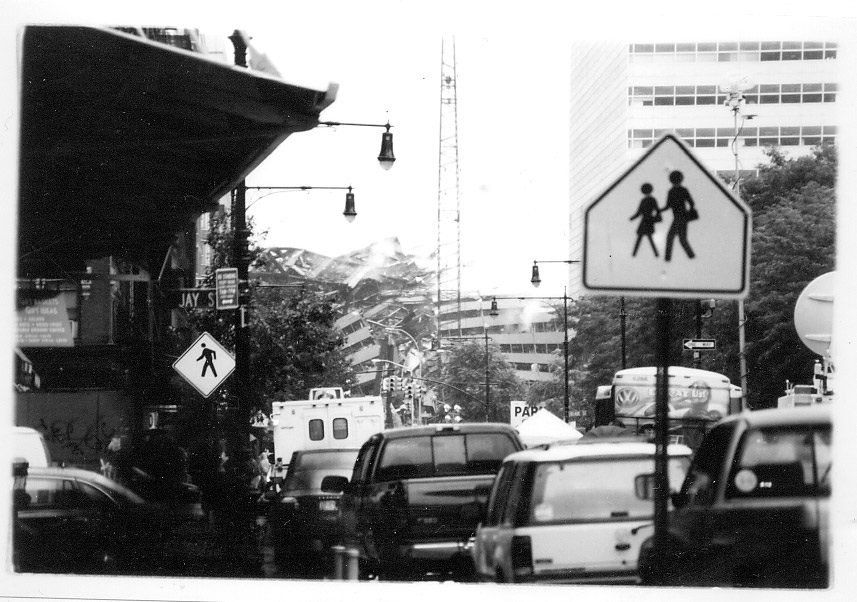
I made these photos at various times of the day and night and at various locations around Ground Zero, 9/13-9/21/2001. When I got the assignment, I grabbed my 35 mm SLR and the last roll of 36 exposure B & W film I had available. So, I had to shoot selectively. These are the results. They have rarely been seen publicly, and some not at all. I'll try to relate the photos to the corresponding text from my entry Special Report: Witness to Disaster. Therefore, it might be helpful to read the text before viewing the photos.

All photos by F. LoBuono. All rights reserved.

This is one of the roof top views from my camera position 40 stories above #40 Harrison St. It is looking south, down the West Highway, into The Pit


This is the same angle down the West Side Highway at night. Crews worked around the clock.


This is also from the rooftop at night, looking south down Greenwich St. The wreckage of #7 WTC can be seen smoldering in the distance.


This is a daytime shot of virtually the same angle looking south down Greenwich.


This is a ground level shot from our position on Greenwich St. #7 WTC lies collapsed in the background.

(Directly Above) My view looking east towards Long Island. The haze created by the dust from the collapsed buildings is clearly visible.


(Above left) My rooftop angle clearly shows the collapsed #7 WTC.


A time exposure looking due south from the rooftop clearly shows The Pit still smoldering.


A night-time time exposure of the same angle.


From Broadway looking east. Only a small section of facade remained, seen on the left.


The remains of the facade are clearly visible in this shot.


(Below) Huge work lights, combined with the spray from the firehouses, made for an eerie glow from "The Pit"


(Above) NYFD worked non-stop at the site. Here crews travel in and out on Greenwich St. The Red Cross, who also played a huge role can be seen here, as well.

(Below) The massive amount of media was everywhere. Here they line the West Side Highway.


Various views of the crews who worked all hours of the day and night and in all weather conditions to capture the story,


(above) Me on the job.


(Left) John Geisler.